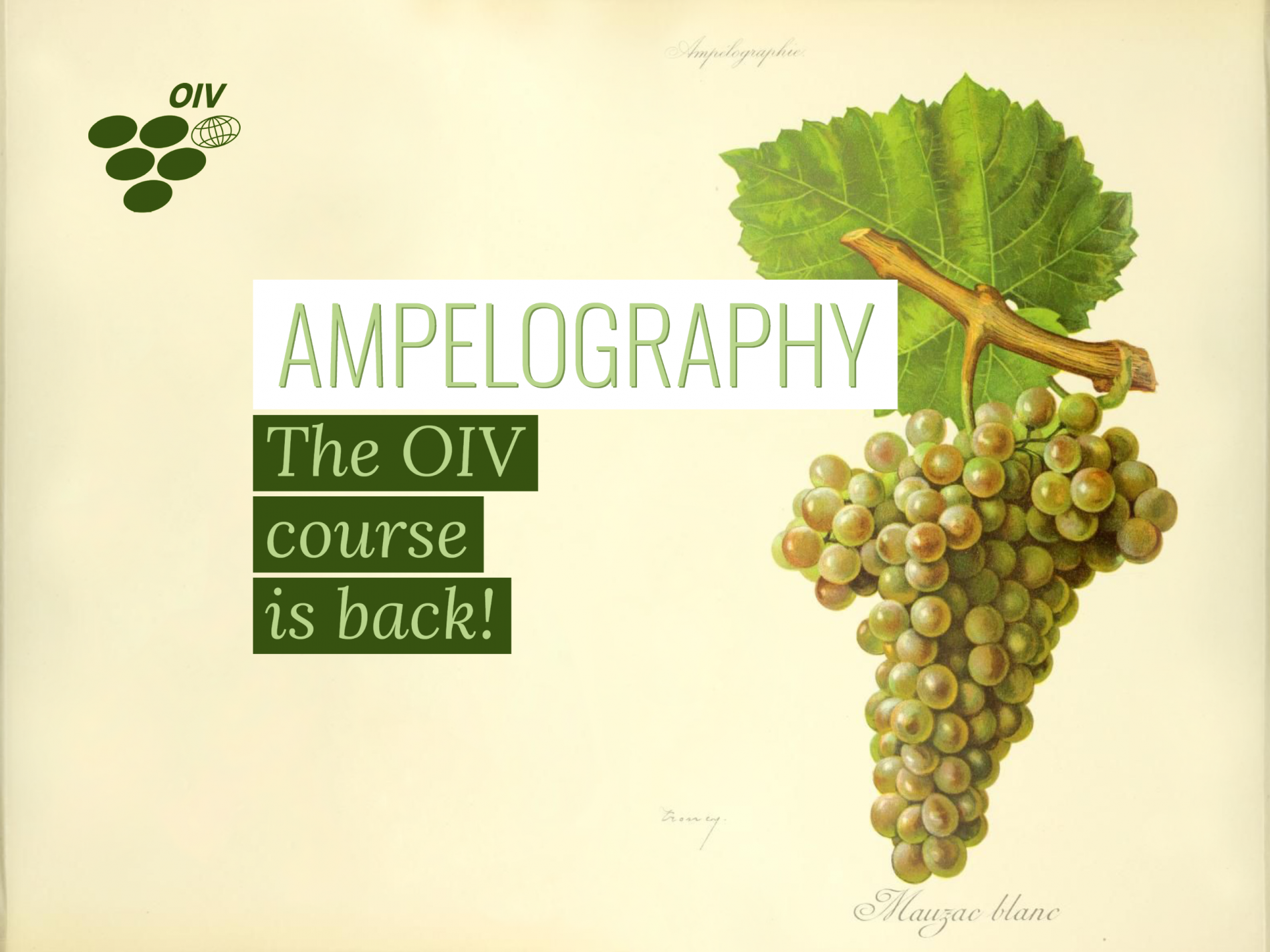
33 years after its first edition, the prestigious OIV International Ampelography Course is coming back.
As the scientific and technical reference in the world of vine and wine, this OIV course in ampelography allows participants to acquire in-depth knowledge in the recognition and understanding of grapevine varieties, helping them to be better prepared for future challenges in the vitivinicultural sector (latest trends in genetic resources, climate change and environment societal expectations, etc...).
Historical background
The OIV's International Course in Ampelography is part of a whole historical background dating back to 1938 when "ampelography" was first cited by the OIV. Nearly 10 years later, in 1949, an ampelography commission was created in order to lead the work relating to the creation of an international ampelographic register.
In the 1990s, considering the importance of identifying varieties in the international vitivinicultural sector and the need to disseminate more widely technical and scientific work in the field of ampelography, the OIV launched a first cycle of courses in ampelography: in 1988 in Italy (ISV Conegliano), in 1990 in France (ENSA Montpellier) and in 1992 in Germany (BZWG-IR Geilweilerhof). Today, the OIV is relaunching this initiative anew with a cycle of international courses in ampelography. This course with practical, leading-edge knowledge will be facilitated by specialists from different countries.
General purpose and how will the course be organised
The main objective is both to train professionals and experts in the field of “Ampelography and Genetic Resources”, and to create a pole and experts network who can exchange continuously around this important topic for the vitivinicultural sector. To achieve this, the courses are designed in collaboration with international actors and the OIV relied on the knowledge and experience of important technical, research and training centres from France - Montpellier, in cooperation with IFV (Institut Français de la Vigne et du Vin), INRAE (l’Institut national de recherche pour l'agriculture, l'alimentation et l'environnement) and the Institut Agro - Montpellier SupAgro - and Spain - the Vine Varieties Collection of "El Encín", Alcalá de Henares, Madrid, belonging to IMIDRA (Instituto Madrileño de Investigación y Desarrollo Rural, Agrario y Alimentario).
Why the OIV aims to promote and disseminate ampelography: A major discipline of current interest
As the scientific and technical reference in the world of vine and wine, the OIV's role is to participate actively in the promotion of this fundamental discipline since knowledge of wine comes from understanding the vine. In reaffirming the scientific and technical nature of ampelography the OIV is emphasizing the fact that this discipline embraces both tradition and innovation. In this rapidly changing world, it is the role of OIV and its experts to contribute to developing and supporting ampelography and vine resources as an important field for the sustainability of the sector.
More information on fees and the registration procedure will be available soon.
For further details, please send an email to: oivampelography@oiv.int

White wine with maceration was introduced into the special wines category in 2020. In consideration of the ancient Georgian method of winemaking in traditional Qvevris, inscribed on the UNESCO Representative List of the Intangible Cultural Heritage of Humanity in 2013, the OIV General Assembly adopted a definition applicable to wines made in Qvevris through Resolution OIV-ECO 647-2020.
Interview with the Georgian Minister for Agriculture
Discussions on white wines with maceration had been started within the OIV at Georgia’s initiative in 2017. Wines produced according to the ancestral Georgian process in earthenware jars, with prolonged contact with the grape skins and stems, are somewhat of a calling card for this country. This production method imparts particular taste characteristics and a sometimes orange-amber colour to wines. The introduction into the OIV International Code of Oenological Practices as a specific category of special wine – alongside ice wines, liqueur wines and other special wines – is a major milestone for Georgia with respect to the recognition of the historical, technical and cultural value of its vitiviniculture.
- The recognition Georgia’s vine-growing history and culture has achieved is no coincidence, but the outcome of a centralised policy of research and promotion. The results of this international recognition are by no means insignificant:
- in 2013, the ancient Georgian method of winemaking in traditional Qvevris was inscribed on the UNESCO Representative List of the Intangible Cultural Heritage of Humanity,
- in 2017, a research article published in the prestigious PNAS (Proceedings of the National Academy of Sciences of the United States of America) reported on a study of biomarkers that indicated the presence of vines in the South Caucasus and Georgian territory at the start of the Neolithic period (6000-5800 BC),
- in 2017, the Guinness Book of Records recognised traces of wine on items excavated from archaeological sites in Gadachrili Gora and Shulaveris Gora as the oldest wine in the world (6000-5800 BC).
The definition of a new product category will promote awareness of wines made in Qvevris among professionals and consumers, so that they may be judged and appreciated taking into account their production method and particular taste characteristics. It will mean that the tannic taste and orange-amber colour can be better explained to consumers and professionals. A distinct, separate category in wine competitions will also be possible.
White wines with maceration are not only produced in Georgia. Other countries, such as France, Italy and Slovakia, also offer orange wines. This new addition to the OIV International Code of Oenological Practices is indeed an international definition.


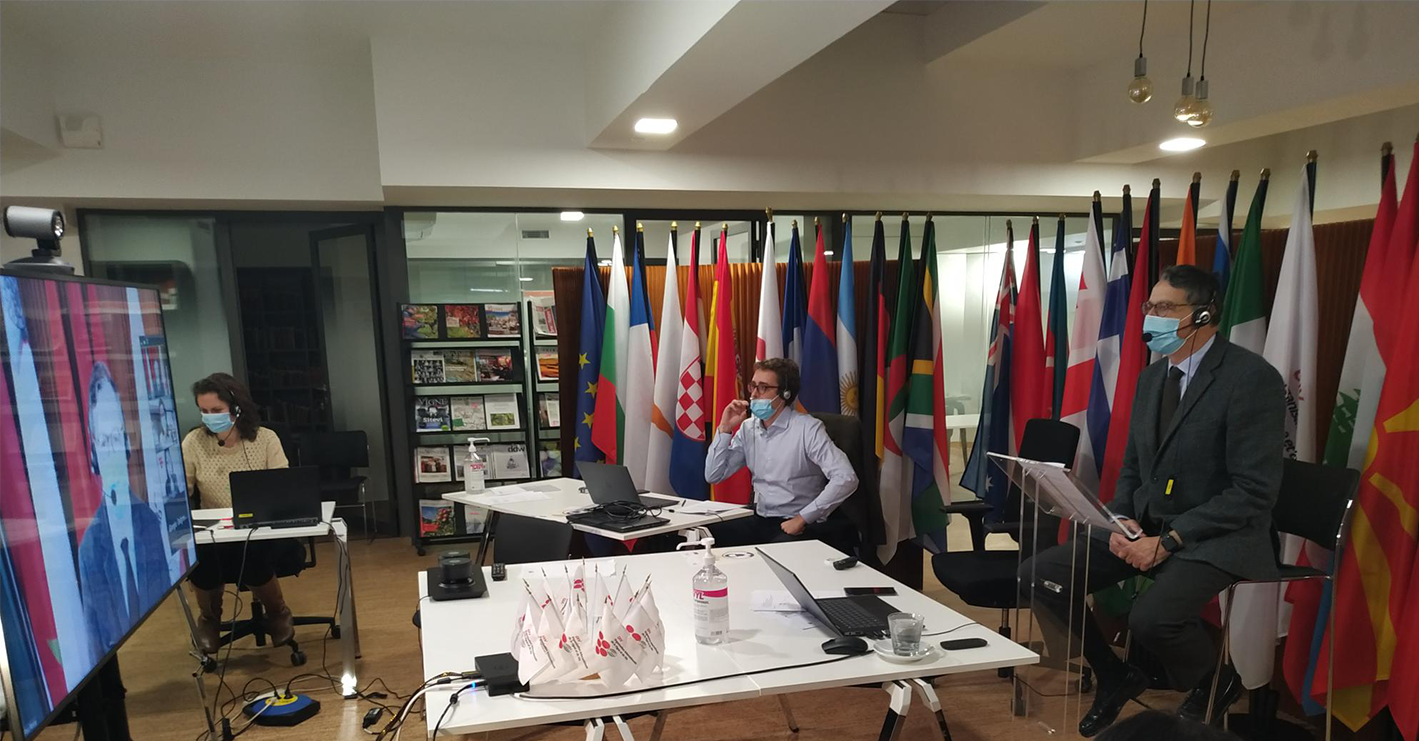
Speaking from the OIV’s headquarters in Paris, by web conference, Director General Pau Roca, presented on 27 October, the first estimates of 2020 world wine production.
- Lower than average production volume in the EU, where measures to reduce the harvest volume had a significant impact in Italy, France and Spain notwithstanding the overall favourable climatic conditions.
- First harvest forecasts in the US indicate volumes in line with 2019, but uncertainty caused by wildfires might lead to further revisions.
- Drop of South America’s wine production, especially in Argentina and Chile due to unfavourable weather conditions.
- South Africa finally back to “normality” after several years of drought.
- Australia records a low harvest due to bushfires while New Zealand shows a record harvest volume in 2020.
Replay
2020 Wine production first estimates