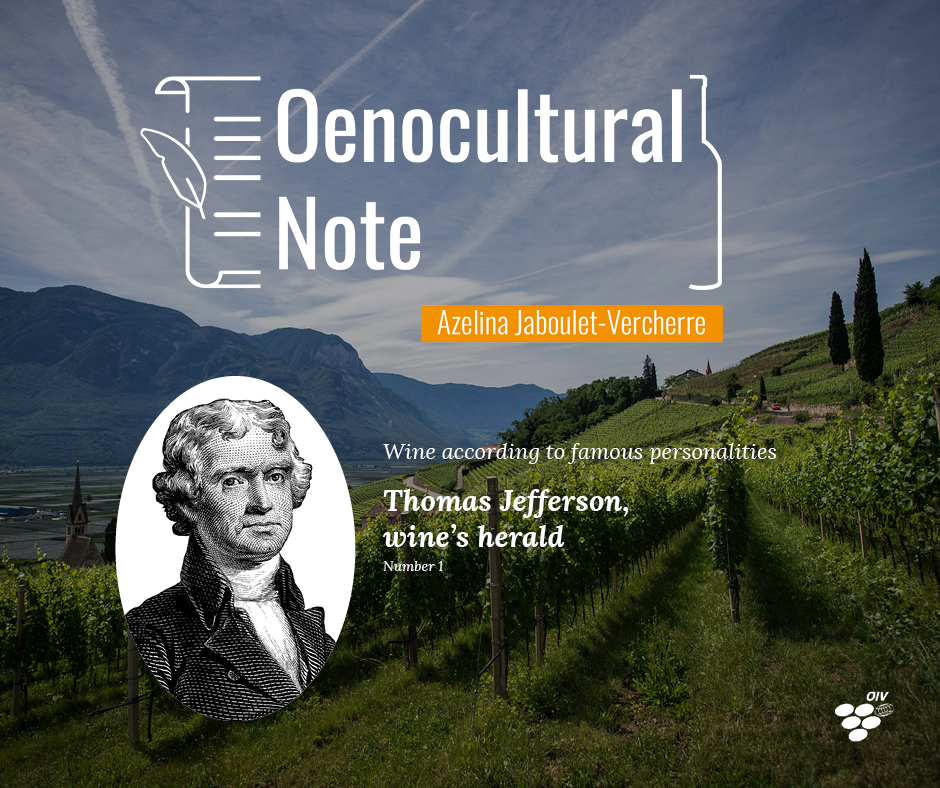
Thomas Jefferson, wine’s herald
Azélina Jaboulet-Vercherre
Associate Professor, Ferrandi Paris
Every man has two countries, his own and France1.
Thomas Jefferson (1743-1826), a Founding Father of the American democracy and author of the Declaration of Independence (4 July 1776), was a passionate advocate of wine. His connoisseurship makes him both a symbol of his time and a pioneer, a tasty paradox.
Wine, the banner of moderation
Cosmopolitism, humanist culture and philosophical opinions: Jefferson championed all facets of the Enlightenment. He was categorical: wine is different from spirits. But he went even further, as a faithful opponent to the early prohibitionist mystique. He showcased wine as a cure for alcoholism, thereby joining a long medical tradition, from the Hippocratic Collection onward, advocating its power as a therapeutic tool.
An ambassador in the vineyards
While in Paris as Minister Plenipotentiary (1784-1789), the “foreign gentleman” (as he liked to call himself) anonymously travelled throughout the French vinelands, further reinforcing his convictions of wine’s benefits on one’s physical and mental health2. His notebooks take us in the footsteps of this aesthete of wine and vineyards, which he also appreciated for their beauty3. The result is an enticing series of highly personalized wine routes, where the picturesque sits alongside detailed observations. Indeed, through his notes, wine appears as a vibrant character. With panache, he depicts inspiring portraits: wine’s hall of fame.
Diplomatic value
Jefferson had trustworthy tastes and held on to his preferences. “America’s first wine aficionado” developed a classification for Bordeaux wines – a classification comparable to the famous 1855 list, based on data provided by the industry’s brokers at the request of Napoleon III4. Jefferson also took into account material (price and fiscal impact) and technical (viticultural methods) aspects. Yet, his approach appears as more sensory, more sensualist.
Jefferson did not content himself with the two starred wine regions (Burgundy and Bordeaux); he also surveyed southern France, northern Italy, as well as the Rhine, Moselle and Champagne. Over time and as his tasting profile flourished, he complemented his wine journey with the Rhône, the Languedoc-Roussillon, Spain and even Portugal. His curiosity, energy and ability to concentrate all served his cause, leading him to brave the difficulties of shipping wine (duration, weather conditions, pirate attacks). He preferred to trade directly with producers - for pricing conditions as much as for conversation - to such an extent that he became an advisor to the tax authorities. A clever use of the diplomatic channel to be reconsidered.
A celebration of wine
Thanks to Lafayette, to name just one of his illustrious acquaintances, he entered the most brilliant circles of Enlightened Paris. One can easily envision him in these salons, his mind as ‘brisk’ as some of the wines he loved.
Jefferson was by no means an ordinary wine collector. He considered drinking as a celebration, yet to be handled with care. Wine is a serious thing, he devised, unchallenged. Every step is crucial to the optimal wine experience, a combination of sensation, emotion, and culture.
The gentleman diplomat found in wine the perfect tool to illustrate the cardinal virtue of temperance. He emphasized its social role, “savoir-vivre” being at the core of the “art of drinking”. And at the time, holding one’s liquor was the sign of Frenchness – something he deemed worth exporting and duplicating.
Let us give justice to Jefferson’s message: wine, the civilizational drink par excellence, is education’s best ambassador.
-----------------------------
1 Thomas Jefferson, cited in Bernard Ginestet, Thomas Jefferson à Bordeaux et dans quelques autres vignes d’Europe (Bordeaux: Mollat, 1996, p. 118).
2 From the rich bibliography on Wine and Jefferson, see John Hailman, Thomas Jefferson on wine (Jackson: University Press of Mississippi, 2006); Jim Gabler, Passions, The Wines and Travels of Thomas Jefferson (Baltimore: Bacchus Press, 1995); Jim Gabler, An Evening with Benjamin Franklin and Thomas Jefferson: Dinner, Wine, and Conversation (Baltimore: Bacchus Press, 2006).
3 Thomas Jefferson, Thomas Jefferson’s European Travel Diaries, ed. James McGrath Morris, Persephone Weene (Ithaca: Isidore Stephanus Sons, 1987).
4 Frederick J. Ryan, Jr., Wine and the White House: a History (The White House Historical Association, 2020, p. 20).


The OIV welcomed the signature of a consortium agreement between Viña Concha y Toro (Chile), Moët-Hennessy (France), Sogrape (Portugal), Familia Torres (Spain) and Yalumba Family Winemakers (Australia) with the objective of contributing to promoting and supporting the Organisation’s technical and scientific diffusion.

General purpose and how will the course be organised
The main objective is both to train professionals and experts in the field of “Ampelography and Genetic Resources”, and to create a pole and experts network who can exchange continuously around this important topic for the vitivinicultural sector. To achieve this, the courses are designed in collaboration with international actors and the OIV relied on the knowledge and experience of important technical, research and training centres from France and Spain:
- France - Montpellier, in cooperation with IFV (Institut Français de la Vigne et du Vin), INRAE (l’Institut national de recherche pour l'agriculture, l'alimentation et l'environnement ) and the Institut Agro Montpellier SupAgro -, with its extensive experience in this area, was initially scheduled to run the course in July 2021. Given the international health context and in order to provide better conditions for the participants, this important worldwide ampelography centre has decided to postpone the course due to force majeure to July 2022.
- Spain - Madrid. For its first edition1 the OIV International Course in Ampelography should take place at the beginning of September 2021 with the Vine Varieties Collection of "El Encín", Alcalá de Henares (Madrid), belonging to IMIDRA (Instituto Madrileño de Investigación y Desarrollo Rural, Agrario y Alimentario). It is an important centre of reference in the Community of Madrid and Spain where the agri-food and agro-environmental research projects are carried out.
In the following years the OIV wishes to expand this pole and experts network and carry out the course in other countries in Europe, and subsequently in the Southern Hemisphere. In this sense the 5th training day is dedicated to the next country hosting the International Ampelography Course and to the evaluation of the acquired knowledge.
To guarantee a harmonisation and training quality in the courses run in the different countries, an evaluation of the acquired knowledge will be carried out and the OIV will deliver a course certificate to attest attendee participation.
__________________
1 The 2021 edition will depend on the health context due to COVID. More information to come in May.

Who can apply?
Vitivinicultural sector professionals, researchers: a diploma in agronomy sciences or equivalent experience in this area is required.
The OIV course in ampelography brings comprehensive knowledge in the science of grapevine varieties to all professionals of the vitivinicultural sector. Initially the courses are intended for professionals working in the fields of viticulture, genetic resources, plant material of the vine or in the field of research. The following years will be open to other professionals in the sector: participants wishing to update their knowledge in ampelography and / or knowledge of the vine and its varieties, experts in the vitivinicultural sector to enhance their activity through knowledge of grapevine varieties and who wish to share additional information with the general public eager to know more and more about the vine, its varieties and the products they consume.
The following years will be open to other actors in the sector: any experts wishing to update their knowledge in ampelography, a field which is undergoing major changes; professionals in vitivinicultural tourism.
Why enrol in this course?
The present-day vitivinicultural sector is facing increasing environmental and social awareness and good management of the genetic resources of vine now clearly the only viable way to meet these challenges. Our sector is fully aware of these challenges which are at the heart of the OIV's Strategic Plan 2020-2024.
Other concerns have arisen such as the revaluation of old, native grape varieties, adaptation of foreign grapevine varieties or the consideration of new varieties (for example those resistant to biotic and abiotic stress).
Course overview:
- Language: Spanish / English / French
- 15 participants in order to respect social distancing
- 5-day course
- Practical, leading-edge knowledge
- Highly-qualified teachers from various countries
- The assurance of an international network of experts in the field
- Yearly registration (each country edition will require its own registration procedure)
- An OIV course certificate in ampelography
More information on fees and the registration procedure will be available soon.
For further details, please send an email to: oivampelography@oiv.int
Related news