
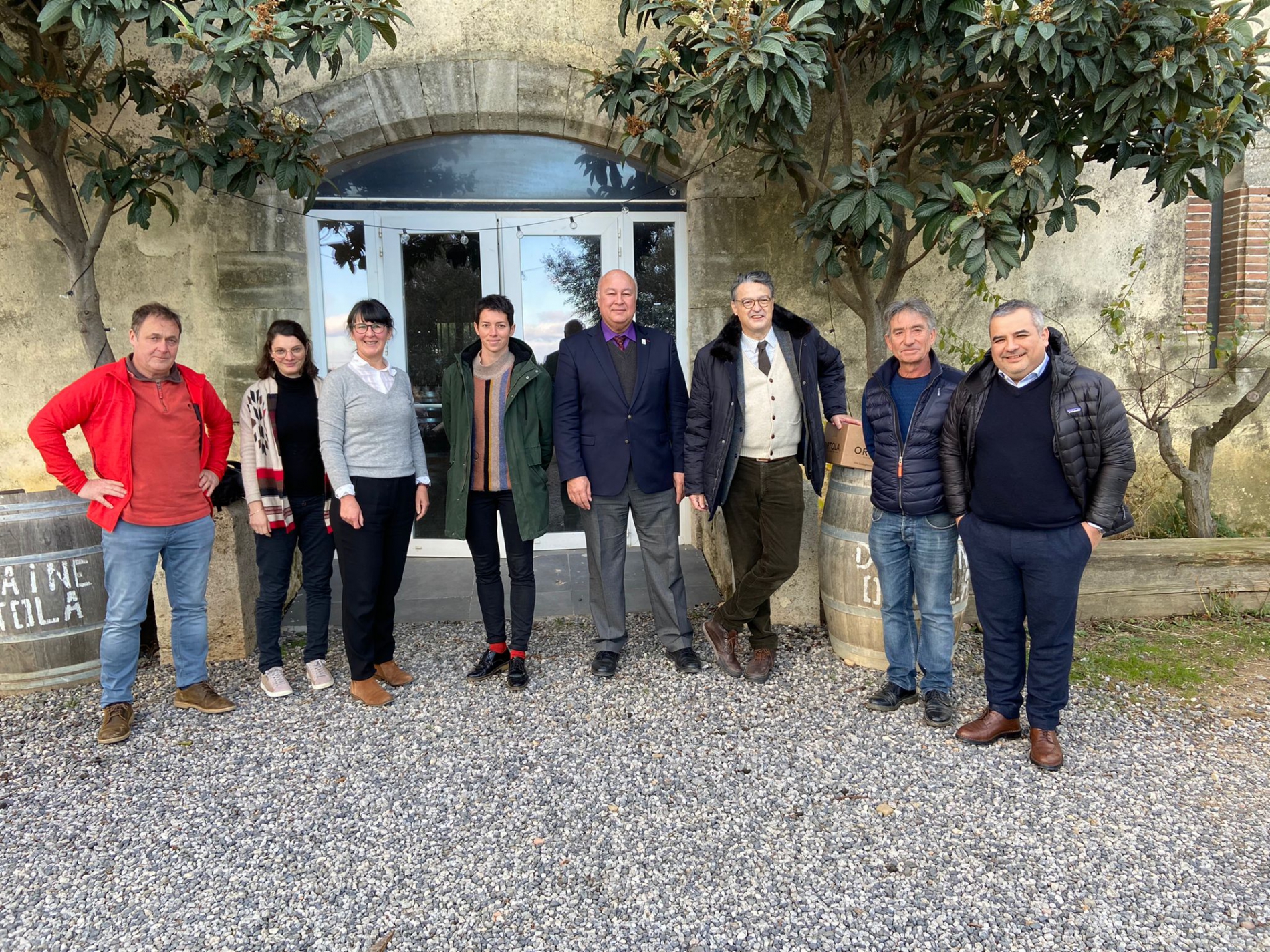
On 2 December 2021, OIV Director General Mr Pau Roca visited the Montpellier region for a day dedicated to the theme of “Sustainable viticulture: the role of agroecology and soil management”. This visit was also about deepening relations between the OIV and the “4 per 1000” initiative, thanks to the attendance of its Executive Secretary, Mr Paul Luu.
It was held at the Notre Dame du Quatourze estate owned by Mr Georges Ortola, who presented the agroecological practices that are implemented on his estates: inter-row cover cropping, tillage reduction, return of pruned canes to the soil, grazing, etc. The importance of good pruning practice has also been emphasised by Mr Alain Canet, President of France’s Centre National d’Agroécologie, who pointed out that pruning problems were recurrent in vineyards and had negative impacts on vine health. Florence Jard, from the “Pour une Agriculture du Vivant” association which works for the transformation of the agri-food sector to agroecology, gave a presentation of the Regeneration Index applied to vines – this makes it possible to evaluate holdings’ agroecological level.
“There was a shared vision of the importance of disseminating these practices to the sector as a whole.”
This day allowed for a rich exchange of ideas between stakeholders practising agroecology on a daily basis and institutional stakeholders. There was a shared vision of the importance of disseminating these practices to the sector as a whole. The OIV, via the “Viticulture” Unit led by Mr Alejandro Fuentes Espinoza, who is also a member of the “4 per 1000” initiative's Scientific and Technical Committee, takes this topic very seriously.
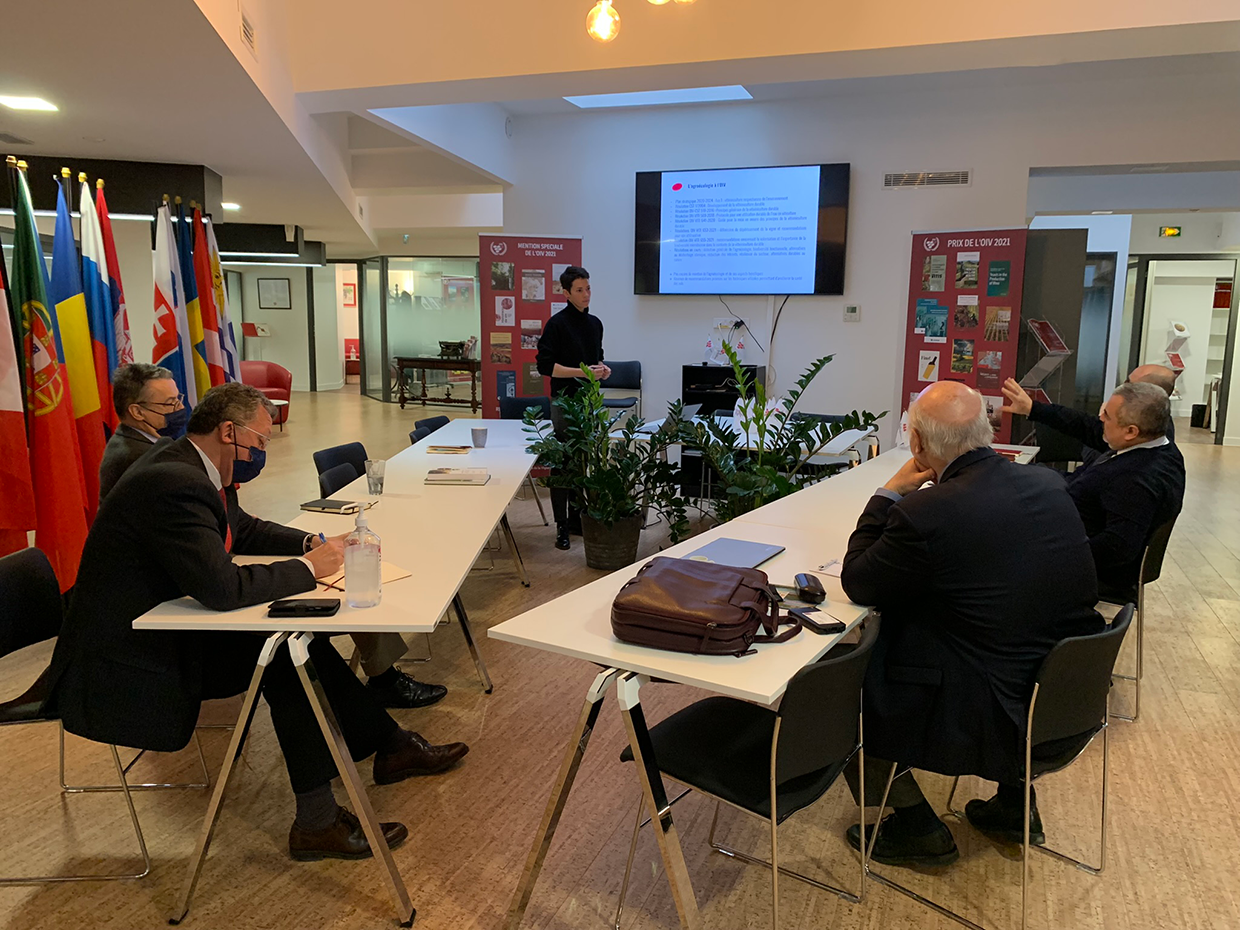
On 19 January 2022, another meeting was held between the executive bodies of the OIV and the “4 per 1000” initiative to contemplate the details of this collaboration. On this occasion, Ms Anne Reutin, a researcher at the OIV, presented her work on carbon issues in the vitivinicultural sector and the importance of taking these issues in hand in political, technical and scientific terms. Both institutions envisage working together and developing key areas of work as well as discussions to achieve progress at the international level on this major topic of soil health and safety.
Read Russian version here


The International Organisation of Vine and Wine (OIV) in cooperation with the French National Institute of Wine (IFV), is organising an international symposium on following topic: The Vitivinicultural sector: which tools to face current challenges?
The symposium will be held in the frame of the International Horticultural Congress (IHC) is the most important scientific event organised every four years since 1959 in the fields related to horticulture (fruit, vegetables, aromatic and medicinal plants, seeds and roots, ornamental plants, landscaping, vineyard.) under the auspices of ISHS (International Society for Horticultural Science).
ISHS is a truly global network comprising over 6,000 members. Its aim is to promote and foster research and education in horticultural science and to facilitate cooperation and knowledge transfer on a global scale through events and publications.
This symposium will address some of the major challenges facing viticulture for grape, raisins, juices and wine production worldwide: grapevine decline, soil preservation and management, and grapevine genetic diversity. A specific session will address the current challenges in the production of table grapes, dried grapes and non-fermented beverages.
The following topics will be developed during the symposium :
• Facing grapevine decline
- Abiotic and biotic stress factors: climate change, harmful organisms, etc.
- Vineyard management: viticulture practices, training systems, landscape management etc.
- Economic and societal impact of grapevine decline
• Sustainable management and conservation of vineyard soils
- Soil conservation
- Systemic and integrated management to improve soil quality: functional biodiversity, soil microbiota, etc.
- The contribution of soil in climate change mitigation: carbon sequestration, low emission soil management practices, etc.
- Impacts of climate change on soil composition and activity.
• Preservation and improvement of grapevine genetic diversity
- Resistant and ancient varieties to meet production and consumption challenges in a context of sustainability of the sector.
- Ampelographic and molecular techniques for variety identification and selection.
• Current challenges of viticulture in the production sector of table grapes, dried grapes and unfermented beverages
- Technical and economic challenges in table grape and dried grape production
- Food and health related challenges for producers and consumers of table grapes, dried grapes, and non-fermented beverages
- Grapevine breeding programs: what are the specificities for the table grapes and dried grape sector?
Submit your abstract here before Decembre 20th.
Key Speakers :
Cornelia Rumpel, CNRS, France and Gregorio Muñoz Organero, IMIDRA, Spain
Where ?
Angers, France
When?
