




Photo: Bekir Özden
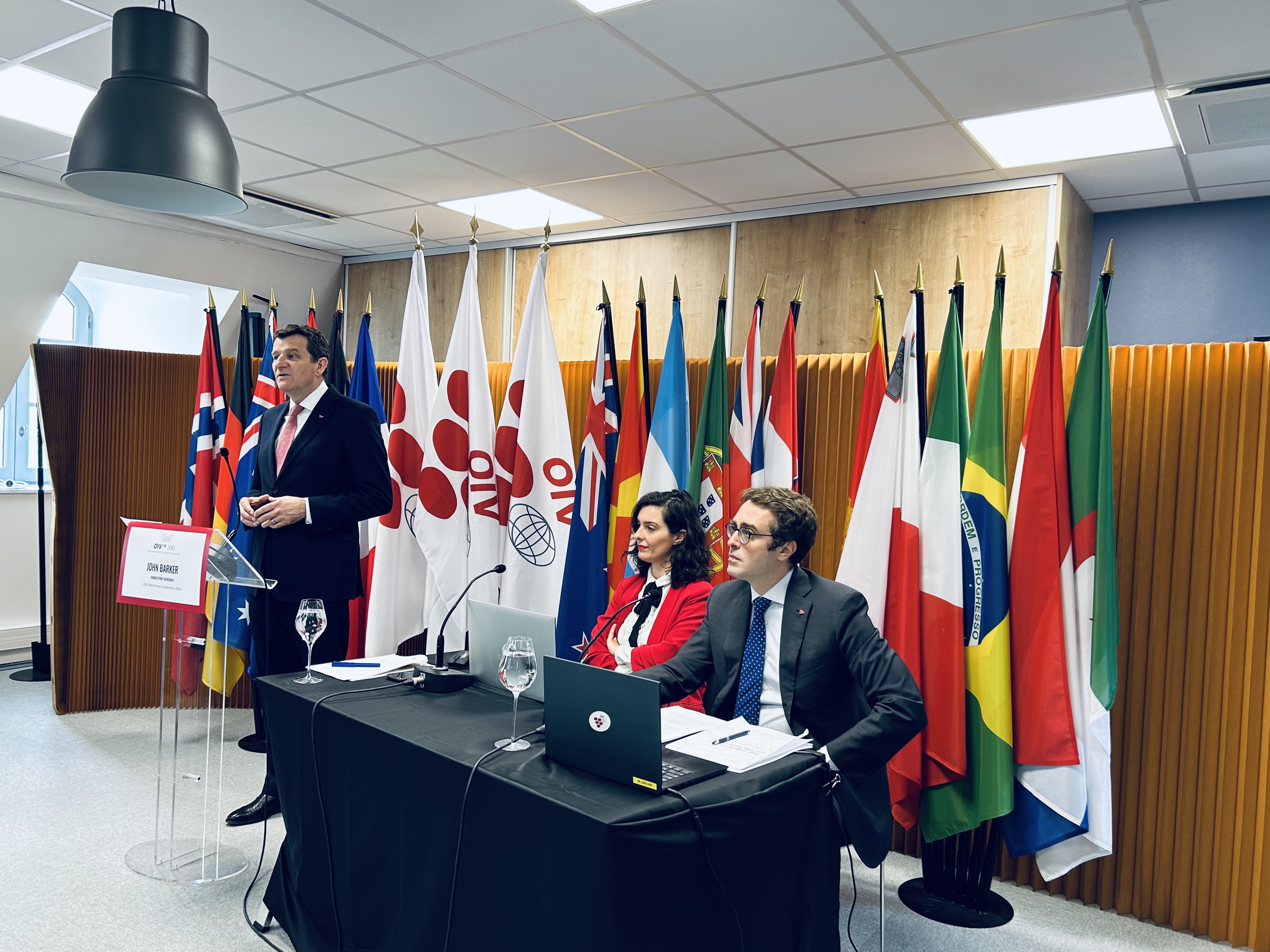
OIV - 16/07/2012 - The 10th General Assembly of the International Organisation of Vine and Wine (OIV), which met on 22 June 2012 in Izmir (Turkey), adopted a total of 38 resolutions.
Decisions on Viticulture
- After completing its Descriptor list for grape varieties and Vitis species in 2007, the OIV adopted an update to the descriptive sheets for the varieties of Vitis spp. This was necessary in order to be able to update its publication, "Description of grape varieties throughout the world". For practical reasons, this description is presented in two documents, a "principal" and a "supplement" (Resolution OIV-VITI 467-2012).
- After adopting the definition of terroir in vitiviniculture in 2010, the OIV has gone a step further by adopting a vitiviniculture zoning methodology, on both a soil and climate level (Resolution OIV-VITI 423-2012). The methodology includes the simple and necessary steps for obtaining good results. After these steps a series of validation methods for zoning was also proposed; all based on a large list of bioclimatic indices and bibliographic references.
- The HACCP system is most often applied to processed agri-food products (wine, milk, etc.). For the first time, the OIV has decided to adopt a resolution that adapts this system to grapes for different purposes and uses. The application of this system to wine grapes is given as an example in the appendix, leaving the application for table grapes and raisins for future works (Resolution OIV-VITI 469-2012).
Decisions on Oenological Practices
Several resolution concerning new oenological practices will be added to the International Code of Oenological Practices, and in particular:
- Oenological practices relating to the dealcoholisation of wines. In fact, the OIV adopted 2 resolutions, one on the correction of the alcohol content in wines (Resolution OIV-OENO 394B-2012) which, in order to improve the taste balance, authorises a maximum 20% reduction in the alcohol content of wines. The products that result from this practice must still comply with the definition of wine and in particular, the alcoholic strength by volume limits. The second resolution concerns the dealcoholisation of wines (Resolution OIV-OENO 394A-2012) which allows the dealcoholisation of wines, without a limit, with the aim of improving vitivinicultural products with a reduced or low alcohol content. The products that result from this practice do not cover wines in the sense of the OIV's definition of wine.
- A series of oenological specific practices for aromatised wines, beverages based on vitivinicultural products and wine-based beverages (Resolution OIV-OENO 439-2012). These practices satisfy new requirements such as respect for the environment, consumer protection, health aspects related to the use of additives and allergenic ingredients, and also the changing tastes of consumers in order to create new markets for these categories of wines.
- Acidification by treatment with cation exchangers. The OIV now allows treatment with cation exchangers for the acidification of musts (Resolution OIV-OENO 442-2012) and for the acidification of wines (Resolution OIV-OENO 443-2012). Various detailed provisions also accompany this practice.
- De-acidification using an electromembrane process (electrodialysis with bipolar membranes) of musts (Resolution OIV-OENO 483-2012) or wines (Resolution OIV-OENO 484-2012). These practices are defined as physical methods of ionic extraction from the must or wine under the action of an electric field using permeable membranes with anions on the one part and bipolar membranes on the other in order to manage the reduction in the titratable acidity and actual acidity (increase in the pH) of the wine.
- A general file covering the reduction of the sugar content in musts which describes the objectives and the instructions for achieving those objectives (Resolution OIV-OENO 450A-2012). At the same time, a specific application on the reduction of sugar content in musts through membrane coupling was adopted (Resolution OIV-OENO 450B-2012). This practice consists in extracting the sugar from a must through membrane coupling combining microfiltration or ultrafiltration with nanofiltration or reverse osmosis. Various detailed provisions also accompany this practice.
- A new resolution describes the molecular biology tools used to identify lactic bacteria in grapes and wine. This guide is intended to assist laboratories performing microbiological analyses for the identification of lactic bacteria. Culture dependant and independent methods can be used in the identification and characterisation of lactic bacteria at the different winemaking, ageing and storage steps (Resolution OIV-OENO 409-2012).
- Molecular biology methods for the detection of biogenic amine-producing lactic bacteria in wine. (Resolution OIV-OENO 449-2012). These PCR methods are especially useful in detecting specific lactic bacteria strains that have coding genes for the enzymes involved in biogenic amine production in wine.
- The guidelines relating to the criteria for the characterisation of Saccharomyces yeasts from the vitivinicultural environment (Resolution OIV-OENO 370-2012). These guidelines cover Saccharomyces yeasts and their respective hybrids and comprise a compilation of characterisation criteria for yeasts that prove useful during the isolation and characterisation process for winemaking yeasts for a quality-focused wine production.
Decisions on Specifications of Oenological Products
The following monographs have been added to the International Oenological Codex, particularly:
- A monograph relating to yeast protein extracts that was added to the oenological practice adopted in 2011. Different detailed specifications also accompany this monograph (Resolution OIV-OENO 452-2012).
- The modification of the existing monograph on lactic bacteria in order to take account of the particularity of certain wines, especially those characterised by low pH levels and high malic acid content (Resolution OIV-OENO 494-2012).
- A series of modifications to the monographs relating to enzymes. In particular, those covering the general monograph on enzymatic preparations (Resolution OIV-OENO 485-2012), those relating to the determination, in enzymatic preparations, of polygalacturonase activity (Resolution OIV-OENO 364-2012), of pectin methylesterase activity (Resolution OIV-OENO 363-2012), of β-D-glycosidase activity (Resolution OIV-OENO 489-2012), of glycosidase activities (Resolution OIV-OENO 451-2012), of endo--α(1,5) -arabinanase activity (Resolution OIV-OENO 412-2012), of cellulase activity (Resolution OIV-OENO 486B-2012), of galactanase activity (Resolution OIV-OENO 490-2012), of pectinlyase activity (Resolution OIV-OENO 491-2012).
Decisions on Methods of Analysis
During this same session, new methods of analysis to be published in the International Compendium of Methods of Analysis of Wines and Musts, or modifications to the methods were adopted.
- A method for the determination of lysozyme using high-performance capillary electrophoresis. The principle consists in directly injecting wine samples into the capillary electrophoresis instrument after filtration and dilution as needed. The quantification of lysozyme is performed against an external standard. (Resolution OIV-SCMA 385-2012)
- Specific methods for the analysis of grape sugars (rectified concentrated grape musts). These methods concern in particular, the total cations: the test portion is treated by a highly acidic cation exchanger. The cations are exchanged against H+. They are expressed through the difference between the total acidity of the effluent and that of the test portion. Other methods cover heavy metals, and especially the determination of lead using ETAAS, as well as the determination of lead using inductively coupled plasma mass spectrometry (ICP-MS) (Resolution OIV-SCMA 419B-2012).
- A Quechers extractive method for the assay of pesticides in wine. This method defines the extraction methods for pesticide residues in wine using the Quechers method and the analysis of the extracts obtained by GC/MS and/or LC/MS-MS. The principle lies in extracting a sample using acetonitrile, followed by liquid-liquid partitioning induced by adding magnesium sulphate and sodium chloride and buffering with citrate salts. The extract is then purified using an amino adsorbent. To improve their stability during storage, the extracts are acidified by adding a small quantity of formic acid (Resolution OIV-SCMA 436-2012).
- An update to the method for determining the density of wine (method OIV-MA-AS2-01A) by adding the method for determination by electronic densimeter using a frequency oscillation (Resolution OIV-SCMA 437-2012).
- Two methods for determining natamycin in wine, principally based on High-Performance Liquid Chromatography (HPLC) with Diode Array Detection (DAD) or High Resolution Mass Spectrometry (HR/MS). The first (HPLC/DAD) is based on directly injecting the wine samples into the HPLC system. In the second (LC-HR/MS), the level of natamycin in the wine is determined by directly injecting the sample into a detection system using liquid chromatography coupled with high resolution mass spectrometry. At the same time, the OIV Member States decided to adopt a provisional intervention limit of 5 µg/L for natamycin (Resolution OIV-SCMA 461-2012).
- A modification to the method for determining dry extract on the definition of sugar inversion (Resolution OIV-SCMA 465-2012).
- A modification to the method for evaluating the sugar content of musts, concentrated musts and grape sugar by refractometry by adding data relating to the alcoholic strength by volume (Resolution OIV-SCMA 466-2012).
Decisions on Economy and Law
- The OIV Member States adopted two new definitions for products with a reduced or low alcohol content. One of these was the definition for beverages from the partial dealcoholisation of wines, for which the alcoholic strength by volume must be between the minimum alcoholic strength by volume and 0.5% vol. (Resolution OIV-ECO 433-2012) and the other, the definition for beverages from the dealcoholisation of wines, for which the alcoholic strength by volume must be less than 0.5% vol. (Resolution OIV-ECO 432-2012).
- "Wine vinegar" is now defined and incorporated in Chapter 6, "Products derived from grapes, grape must or wine" in Part 1 of the International Code of Oenological Practices (Resolution OIV-ECO 401-2012).
- An important update to the OIV International Standard for Labelling Spirituous Beverages of Vitivinicultural Origin was adopted (Resolution OIV-ECO 402-2012). This is the first update since 2003. This resolution is an important step in standardising labelling rules for spirituous beverages of vitivinicultural origin. The standard is a recommendation by the OIV to Member States and aims to facilitate international trade by providing consumers with accurate information as well as taking into account the development in international regulations particularly in accordance with WTO and TRIPS agreements.
- Finally, the General Assembly adopted the general principles of organic vitiviniculture (Resolution OIV-ECO 460-2012) which should form the basis for the definition of guidelines for organic vitivinicultural production. The resolution contains six principles, including the ban on the use of GMOS and inputs derived from GMOs.
Download the list of adopted resolutions in PDF
© OIV.INT